Accelerated Compute Under Pressure: Rethinking Enterprise AI Budgets in an Era of GPU Scarcity
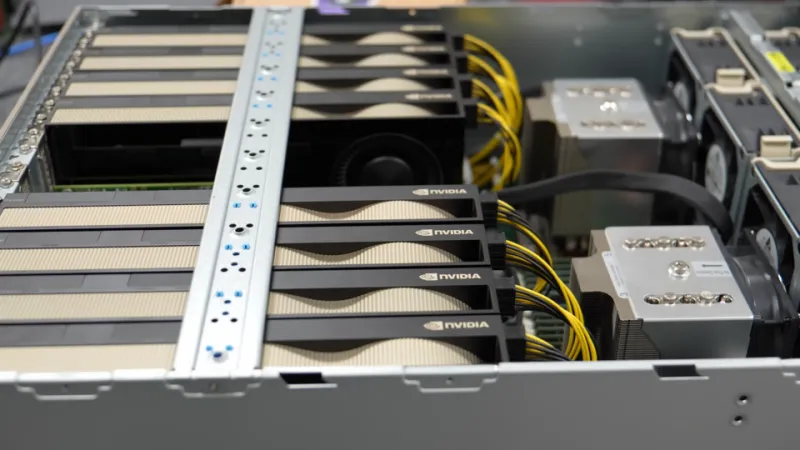
Photo: Lawrence Systems, CC BY 3.0, via Wikimedia Commons
For most of the past decade, enterprise technology budgets operated on a relatively stable assumption: cloud compute resources would remain broadly available, with pricing that trended downward over time as infrastructure costs declined and competition among providers intensified. That assumption no longer holds for the category of compute that matters most to AI-driven organizations.
GPU-accelerated instances—the infrastructure backbone of machine learning training, large-scale inference, and generative AI workloads—are now subject to supply constraints that are reshaping how enterprises plan, price, and prioritize their AI investments. The financial implications extend well beyond the line item for cloud compute, touching workforce planning, product roadmaps, and competitive positioning in ways that most finance organizations have not yet fully internalized.
The Supply Gap and Its Immediate Financial Effects
The mechanics of the current GPU shortage in cloud marketplaces are worth understanding precisely, because the financial effects differ depending on how an enterprise is attempting to access accelerated compute.
For organizations relying on on-demand GPU instances, the primary experience is availability—or the lack of it. Major US cloud providers have, at various points over the past eighteen months, displayed limited or no availability for their most capable GPU instance types in specific regions. Enterprises that built their AI workload scheduling around on-demand access have encountered queuing delays that extend model training timelines by days or weeks, with direct consequences for product release schedules and the internal cost of engineering time.
For organizations using spot instances to reduce GPU costs, the scarcity dynamic has manifested differently. Spot pricing for GPU instances has increased materially in high-demand regions, compressing the discount relative to on-demand rates that made spot compute financially attractive in the first place. Interruption rates have also risen, meaning that long-running training jobs face a higher probability of being terminated mid-execution—a particularly costly outcome when the interrupted job represents dozens of hours of accumulated compute.
A software company in the Pacific Northwest that had structured its entire model development pipeline around spot GPU instances reported in an internal review that its effective cost per training run had increased by approximately 40 percent over a twelve-month period, not because of any change in its own usage patterns, but because the market conditions underlying its cost model had shifted.
Vendor Pricing Power and the Lock-In Premium
Scarcity creates pricing leverage, and cloud providers have not been reluctant to exercise it. Reserved instance pricing for GPU compute—the mechanism by which enterprises commit to one- or three-year terms in exchange for rate discounts—has become a point of significant financial tension. The discounts available on GPU reservations have narrowed compared to those available on general-purpose compute, reflecting the reduced incentive providers have to discount resources that are already in high demand.
More consequentially, enterprises that have built their AI infrastructure deeply into a single provider's ecosystem face a compounding problem. Migrating GPU workloads between cloud environments is not a trivial undertaking. Differences in hardware architecture, software stack compatibility, and data transfer costs create switching friction that effectively increases a provider's pricing power over its existing customers. Finance teams that modeled their AI infrastructure costs assuming competitive market dynamics are now operating in a market that behaves more like a constrained commodity than a competitive service.
This dynamic is particularly acute for Fortune 500 companies that moved quickly to stand up large-scale AI programs in 2023 and 2024, often prioritizing speed over architectural flexibility. Many of those organizations are now engaged in quiet renegotiations with their primary cloud providers, attempting to secure capacity commitments that offer some protection against further price escalation—a process that requires procurement and finance teams to develop a level of technical fluency about GPU workload characteristics that they have not historically needed.
Structural Alternatives That Finance Teams Need to Model
Enterprises that are actively managing their exposure to GPU scarcity are pursuing several strategies that have not yet become standard line items in most AI infrastructure budgets.
Distributed and federated training approaches allow large model training jobs to be decomposed across heterogeneous compute environments, including on-premises GPU clusters, edge hardware, and multiple cloud providers. The engineering overhead is real, but for organizations with sufficient scale, the cost savings and capacity flexibility can justify the investment. Several large US financial institutions have begun piloting federated training architectures specifically to reduce their dependence on any single cloud provider's GPU inventory.
Edge inference is gaining renewed attention as a cost management strategy rather than purely a latency optimization. Moving inference workloads—which represent the ongoing operational cost of AI deployment, as distinct from the one-time cost of training—to edge hardware can significantly reduce cloud GPU consumption without degrading model performance for many use cases. CFOs evaluating AI infrastructure budgets should be asking their technology counterparts whether edge inference has been assessed as a cost lever, not just an architectural option.
Negotiated capacity commitments represent a third avenue that requires finance and procurement involvement earlier in the planning process than is typical. Several cloud providers have introduced private capacity reservation programs that allow enterprises to secure GPU availability guarantees in exchange for longer-term financial commitments. These arrangements are not universally favorable, and the terms vary considerably, but for organizations with predictable AI workload growth, they can provide both cost certainty and supply assurance that on-demand or spot markets cannot.
What CFOs Should Be Asking Right Now
The GPU scarcity environment has created a category of financial risk that sits at the intersection of technology strategy and capital planning—a space where finance leaders have not always been active participants. Several questions are worth raising in the next budget cycle.
First, what percentage of current AI infrastructure spend is exposed to spot market pricing, and what is the financial sensitivity of the AI program's timeline to spot availability and interruption rates? Second, has the organization's cloud provider relationship been assessed for lock-in risk specific to accelerated compute, and is there a documented contingency if that provider's GPU pricing increases materially? Third, have alternatives such as edge inference, distributed training, or negotiated capacity reservations been formally evaluated and priced, or are they still theoretical considerations that have not entered the budget model?
The enterprises that navigate the current GPU supply environment most effectively will be those whose finance and technology functions are working from a shared, current understanding of the market. The cost assumptions that informed AI infrastructure budgets eighteen months ago are no longer reliable guides. Rebuilding those assumptions around today's supply realities is not optional—it is a prerequisite for making sound financial decisions about one of the most strategically significant technology investments an enterprise can make.